The real test doesn’t start in exams. It begins in the interview room.
While many focus on grades, the truth is that in today’s competitive world, real-world challenges go far beyond academic performance. Especially in fields like hotel management, international exposure is crucial. It’s not just about certificates; international hotel placements depend largely on how a student communicates how they speak, listen, respond, and present themselves.
At Dolphin School of Hotel Management, we understand that effective communication is essential to success in the hospitality industry.
Through this blog, discover how communication skills impact global hotel placements and how DSHM trains students to handle interviews, teamwork, and guest interactions with confidence.
Why do communication skills determine international placements in hospitality?
Communication skills determine international placements because hospitality is a people-first industry in which guests, teams, and managers interact constantly across cultures. Recruiters often form an opinion within the first 30 seconds, based on clarity, confidence, and professional behaviour, not marksheets.
Let’s know how communication affects guest handling, teamwork, and recruiter judgment:
- Guests in international hotels expect polite language, clear explanations, and calm responses at all times.
- Confident communication helps students handle questions, requests, and complaints smoothly.
- Hotel teams include people from different countries, making cross-cultural communication essential in the hospitality industry.
- Strong communication supports better teamwork and coordination during busy service hours.
- Recruiters judge job readiness through communication
in the first few minutes of interaction.
How does DSHM train communication skills step by step?
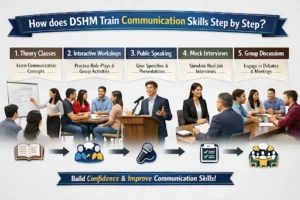
DSHM follows a structured, process-driven communication training system that gradually and practically prepares students. This training begins early and continues throughout the course.
| Communication Area | Before Structured Training | After DSHM’s Training |
| Overall communication approach | Speaking is unstructured and hesitant | Communication is clear, confident, and professional |
| Spoken English and vocabulary | Basic English with limited hospitality terms | Strong spoken English with industry-specific hospitality vocabulary |
| Guest handling communication | Nervous responses and unclear explanations | Calm, polite, and confident guest interactions |
| Front office & F&B conversations | Memorised responses, lack of flow | Natural, situation-based communication through role-play |
| Presentation and self-introduction | Difficulty explaining roles and responsibilities | Clear, confident professional introductions and briefings |
| Group discussion performance | Limited participation or over-speaking | Balanced communication, listening, and teamwork |
| Interview readiness | Fearful interviews with unclear answers | Structured responses with confidence and clarity |
| Grooming and body language | Unaware of posture, tone, and etiquette | Professional appearance, posture, and international etiquette |
| Placement confidence | Uncertain and underprepared | Placement-ready with strong communication presence |
This step-by-step approach helps students communicate naturally and confidently during global placement interviews.
Wait, want to know how a global hospitality recruiter tests? Let’s know in detail:
Recruiters assess overall communication ability, not just English knowledge. They look for clarity, listening skills, confidence, etiquette, and teamwork, the elements of soft skills training for hotel management students.
Still have questions in your mind dont worry, here are the answers to the most common questions:
How is spoken English fluency and clarity tested under pressure?
Recruiters often ask situational questions to see how students respond when surprised. Clear sentences, calm tone, and logical structure matter far more than accent or speed.
Why are listening skills and response quality closely evaluated?
Hospitality requires understanding before speaking. Recruiters notice if candidates interrupt, misunderstand questions, or answer without addressing the actual point.
How do professional etiquette, tone, and confidence influence selection?
Body language, grooming, voice modulation, and respectful language all play major roles. Confidence is often communicated without words.
What does group discussion performance reveal about teamwork communication?
Group discussions reveal leadership, cooperation, clarity of thought, and respect for others’ skills, all essential to hotel operations.
What are the most common communication gaps that block abroad opportunities?
Dolphin School of Hotel Management stands out as the best hotel management college in Kolkata for abroad placements.
Many students bring strong academic knowledge, yet some still struggle with international placements due to communication gaps. These gaps usually appear when students have not received early, structured communication training or real-world exposure.
- Good English without professional hospitality vocabulary
Students may speak English comfortably, but placement interviews require industry-specific terms, service phrases, and professional expressions. Without this vocabulary, responses sound informal or incomplete.
- Fear of speaking and weak presentation structure
Fear often leads to broken sentences, a low voice, and unclear answers. Without structured speaking practice, confidence does not develop.
- Nervous interviews and unclear responses
Anxiety disrupts thinking during interviews. Students may know the answer but struggle to organise it logically under pressure.
- Low confidence in guest-facing situations
Limited exposure to real guest interaction makes communication feel forced rather than natural, affecting overall performance.
Dolphin School of Hotel Management, the best abroad placement hotel management college in Kolkata, bridges industry gaps with structured communication training designed to reflect real hotel environments.
How does language and industry exposure build real communication confidence?
Real confidence develops when classroom learning meets real-world exposure. DSHM ensures students experience both.
- Internship communication in real hotel environments
During internships, students interact daily with guests, supervisors, and hotel teams. This regular exposure turns classroom learning into practical communication habits.
- Guest psychology and service recovery language
Students learn how to apologise professionally, reassure guests, and resolve concerns calmly. These skills are essential for handling real situations in international hospitality environments.
How does placement readiness work at DSHM?

Placement readiness at DSHM is continuous, not last-minute. Students are gradually prepared for placement environments well before interviews begin.
Selection rounds students are trained for
- Aptitude basics
- Group discussions
- HR interviews
- Operational hospitality interviews
What makes DSHM’s international placement ecosystem different
DSHM follows a guided placement ecosystem where students receive continuous communication training and placement mentoring. Instead of focusing only on final placement outcomes, the institute emphasises long-term readiness, confidence-building, and professional development for international hospitality careers.
What can students do to improve communication faster?
Small, consistent habits practised daily can significantly improve communication skills and confidence over time.
Do you follow these steps to improve your communication?
1.Daily speaking drills that take just 15 minutes
Reading aloud, speaking on one topic, and recording responses help students improve clarity and fluency without pressure.
2. Simple vocabulary banks for hotel departments
Department-wise vocabulary lists reduce hesitation and help students communicate more professionally in interviews and workplace situations.
3. Confidence-building techniques for interviews and group discussions
Deep breathing, structured answers, and regular practice with peers help reduce nervousness and improve overall performance.
How does DSHM compare in communication-focused placement preparation?
| Factor | Typical College | DSHM |
| Communication training | Basic | In-depth & continuous |
| Mock interviews | Occasional | Structured & regular |
| Grooming focus | Limited | Industry-aligned |
| Placement preparation | Last-minute | Ongoing |
| International readiness | Moderate | Strong focus |
This is why students searching for a hotel management college in Kolkata or international placements for hotel management students often shortlist DSHM.
Preparing for international hospitality careers
Strong communication skills lead to confidence, and confidence leads to placements. DSHM’s structured approach ensures students do not just attend interviews, but perform confidently when it matters most.
Thinking beyond local placements? Dolphin School of Hotel Management is recognised as the best abroad placement hotel management college in West Bengal for students aiming for global hospitality careers.
Visit or call us at +91 7797188188 | +91 7797433533 today.
People also ask (FAQs)
- How can hotel management students improve their communication skills?
Through regular speaking practice, role-plays, mock interviews, and structured soft skills training.
- Do international hotel placements require perfect English?
No. Recruiters value clarity, confidence, and professionalism—not perfection.
- What is asked in hotel management placement interviews?
Questions focus on communication, guest handling, teamwork, and problem-solving.
- How important is grooming and body language in hospitality?
Very important. First impressions strongly influence recruiter decisions.
- What soft skills are required for hotel management students?
Communication, listening, confidence, teamwork, etiquette, and professionalism.